




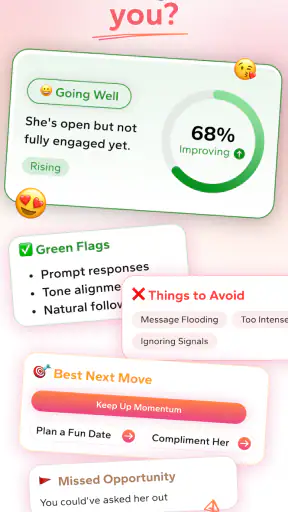
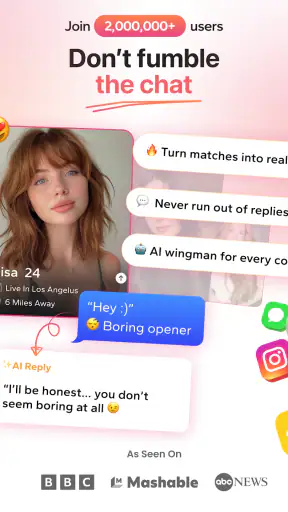
Dating apps already give me plenty to think about: which photo to use, whether a message sounds natural, and how to keep a conversation moving without turning it into an interview. WingAI: Your AI Wingman takes aim at that awkward messaging stage. It is a lifestyle app from Ignition Dating LLC built around an AI dating assistant, and its main appeal is simple: when I do not know what to say, it helps me find a starting point.
That sounds modest, but it addresses a very real problem. Many people are not struggling to meet someone; they are struggling to turn a match into a comfortable conversation. In my experience, the useful part of an assistant like this is not producing a supposedly perfect line. It is reducing the blank-screen feeling so I can reply with something that still sounds like me.
The app is free to install, with optional in-app purchases ranging from $0.99 to $119.99 per item. It is rated Teen, runs on Android 7.0 or newer, and the current version is 2.1.11. Its store summary describes it as an AI Dating Assistant with Rizz, while the short description is simply WingAI. Those labels explain the tone, but the practical question is more important: does an AI wingman genuinely improve dating conversations, or does it make them feel manufactured?
How WingAI’s AI assistance changes the first message
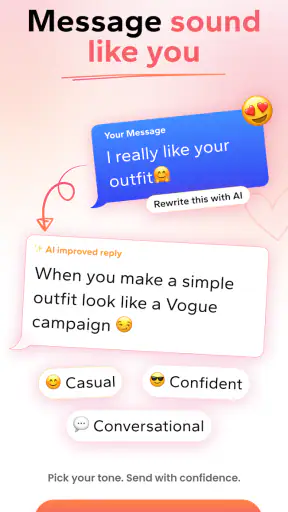
The central capability is message help. Instead of staring at a profile or an unanswered chat and trying to invent a clever response from nothing, I can use the app as a brainstorming partner. That distinction matters. I would not hand over my entire dating life to an automated reply generator, but I can see the value in having a few possible directions when nerves or tiredness get in the way.
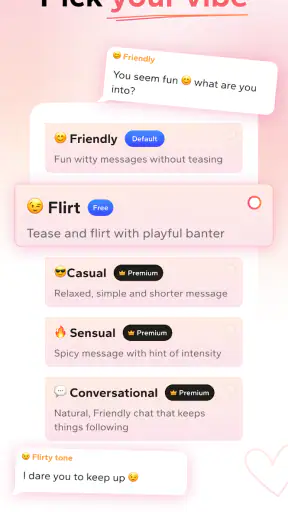
The strongest use is not necessarily a dramatic pickup line. It is finding a tone that fits the moment: playful when the conversation is already light, curious when a profile offers a genuine opening, or relaxed when a previous message needs a natural follow-up. The real benefit is momentum, not magic. A prompt can help me move from hesitation to an actual response, but I still need to choose what feels honest and appropriate.
This is where the “rizz” positioning can be useful and limiting at the same time. If I treat it as permission to be louder, flirtier, or more confident than I really am, the result can feel artificial. If I treat it as a way to explore wording, it becomes more practical. I can compare a direct reply with a warmer one, remove anything that sounds exaggerated, and send a version that matches my personality.
Using suggestions without losing your own voice
My first recommendation is to give the assistant enough context to work with, but not so much that I stop thinking for myself. A short description of the conversation and the outcome I want is more useful than asking for a generic “best line.” For example, the difference between wanting to restart a quiet chat and wanting to suggest a first date should shape the request. The more specific the situation, the easier it is to judge whether the output is actually suitable.
I would also edit every suggestion before sending it. AI-generated dating language often aims for smoothness, while real conversations include small imperfections, personal references, and ordinary phrasing. Removing a grand compliment or replacing a polished phrase with words I would normally use makes the message more believable. This is an important workflow: use WingAI to create options, then use my own judgement as the final filter.
Another useful habit is asking for several different approaches rather than accepting the first answer. One option may be too forward, another too vague, and a third may give me the basic idea I need. I can then combine the useful part with something from the other person’s profile. That turns the app into a writing aid rather than a substitute for attention.
What the experience is like in an everyday situation
Imagine I match with someone during a busy workday. Their profile mentions a weekend hike, but I do not want to send the same tired question about hobbies. I could use WingAI to explore a few ways to respond: a light comment about the hike, a question about the most memorable part, or a message that connects it to my own experience. I would still need to know whether I have actually done anything relevant, but the assistant could help me avoid an empty “Hey, how are you?”
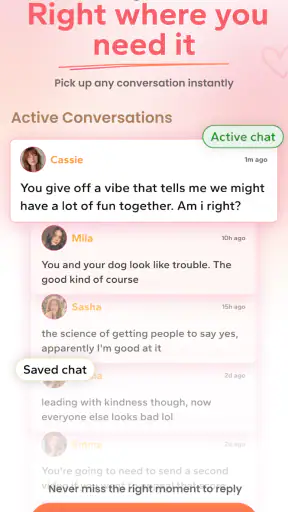
Later, if the conversation becomes quiet, the app may be more helpful as a reset button than as a source of constant entertainment. I can think about what was already discussed and ask for a follow-up that refers back to it. That is better than sending a random question simply to keep the chat alive. The quality of the result depends heavily on the context I provide, so the app rewards users who pay attention to the conversation.
There is also a less obvious benefit for people who over-edit every message. When I spend too long trying to sound impressive, I can lose the natural rhythm of a chat. Seeing a few possible replies can break that loop. I may not use any suggestion word for word, but I can recognize that a simple response is enough. In that sense, the assistant can support confidence even when its exact wording is not worth sending.
Where it fits beside ordinary dating-app tools
Most dating apps already offer the basic ingredients: profiles, matches, chat boxes, and sometimes prompts designed to start conversations. Those tools are better for discovering people and managing the match itself. WingAI focuses on the moment after that, when the interface is empty and the social pressure becomes personal.
Compared with writing everything alone, the advantage is speed and variety. Compared with asking a friend for advice, it is available immediately and does not require explaining the entire situation to someone else. A friend may understand my personality better, though, and can sometimes spot when a message is insensitive or simply not me. WingAI is therefore most useful as a private first pass, while a trusted friend remains better for complicated situations or emotionally important messages.
It also differs from generic writing tools because the goal is not grammar, formal clarity, or professional polish. A dating message can be grammatically perfect and still feel cold. The app’s value depends on whether its suggestions help with tone and social timing. I would choose a general writing assistant for a serious, carefully worded message, but WingAI makes more sense when the problem is conversational confidence.
The best scenario: turning a real detail into a natural opener
The app makes the most sense for someone who has a genuine reason to message but cannot find the right wording. A profile detail, a shared interest, or something already mentioned in the chat gives the assistant material to work with. That is much better than trying to manufacture chemistry from nothing.
For instance, if a match mentions a food they enjoy, I would not ask the assistant to create an outrageous opening. I would ask for a few casual ways to refer to that interest and then choose one that lets the other person answer easily. The best message is usually not the cleverest one; it is the one that creates a comfortable next step. WingAI can help me see those possible next steps when I am stuck.
This workflow also protects against a common dating-app mistake: making the conversation entirely about appearance. A request focused on a hobby, an opinion, or a detail from the profile can lead to a more meaningful exchange. The app cannot make me curious, but it can help me express curiosity in a less awkward way.
Trade-offs I noticed before relying on it
The biggest limitation is that a polished suggestion can still be wrong for the relationship. A line that sounds playful in one chat may sound presumptuous in another. AI does not share the history, humour, boundaries, or emotional context that two people build over time. I have to read the room myself, especially when the conversation involves rejection, vulnerability, or a sensitive topic.
There is also a risk of sameness. If too many users depend on similar AI dating tools, certain phrases and styles may start appearing repeatedly. That can make a message feel less personal, particularly when it contains dramatic confidence that the sender would never normally show. Editing is not an optional finishing touch here; it is what keeps the tool from becoming obvious.
Privacy deserves careful personal judgement too. Dating conversations can contain names, locations, relationship history, and other intimate details. I would avoid sharing anything unnecessary and remove identifying information before asking for help. Even when I want a highly tailored suggestion, I do not need to paste an entire private conversation. A short, anonymized summary is usually enough for the writing task.
The purchase model is another point to consider. The app is free, but optional items can cost from $0.99 to $119.99 each. That is a wide range, so I would pay close attention to what any purchase unlocks and whether I am paying for occasional convenience or building a recurring habit. Someone who only needs help once in a while may find the free starting point sufficient, while a frequent user should decide on a clear spending limit before buying anything.
The Teen content rating also means I would not treat the app as a replacement for mature relationship advice. It is aimed at helping with dating communication, not at resolving serious personal issues or guaranteeing safe interactions. I still need to follow ordinary online-dating precautions, verify who I am speaking with, and avoid letting a confident-sounding suggestion push me into meeting or sharing more than I want.
Who gets the most from this particular assistant
WingAI is a strong fit for people who understand what they want to say but struggle with the first draft. It may be especially useful for shy users, people returning to dating after a long break, and anyone who tends to overthink short messages. It can also help someone who wants to practise different tones before sending a reply, as long as the final message remains personal.
It is less suitable for users who want a complete dating service in one place. This is an app in the lifestyle category centred on assistance, not a replacement for meeting people, deciding who to trust, or building a relationship. If the main problem is finding compatible matches, better profile photos, or safer dating arrangements, a conventional dating platform or a human adviser may be more useful.
I would also skip it if I strongly dislike the idea of AI participating in personal conversations. There is no reason to use an assistant that makes me feel detached from my own messages. A simple notes app, a conversation with a friend, or writing directly in the dating app may be a better choice. The tool only works when its convenience outweighs that discomfort.
On the other hand, the app’s popularity suggests that its basic problem resonates with many users: it has passed one million installs and holds a 4.8 average from around 89 thousand ratings. Those figures do not prove that every suggestion will be good, but they do indicate that the concept has found an audience. I would read that as encouragement to try it, not as a reason to surrender my judgement.
My final take after using it as a writing partner
WingAI: Your AI Wingman works best when I use it as a conversation workshop rather than a charm machine. Its useful capability is narrow but meaningful: it helps turn a vague intention into several possible messages. That can save time, reduce anxiety, and make it easier to refer to something real in another person’s profile or reply.
The trade-off is that convenience can flatten personality. The app cannot know whether a joke fits, whether a compliment is welcome, or whether I am sending too many messages. It also cannot create genuine interest where none exists. I have to supply the attention, boundaries, and honesty that make dating communication worthwhile.
Developed by Ignition Dating LLC, it is free to begin and supports Android devices running version 7.0 or newer. I would recommend trying it for a specific problem—an awkward opener, a stalled chat, or a message that needs a warmer tone—rather than using it to generate every response. That limited approach gives me the benefit of a quick second opinion without handing over my voice.
For someone who regularly freezes at the message box, that may be enough to make a real difference. For someone who already writes comfortably or wants deeper relationship guidance, the usual alternatives will probably serve better. My honest recommendation is to use WingAI sparingly, remove anything that sounds unlike you, and judge success by whether the conversation feels more natural afterward—not by how impressive the first line looks.


